TRANSLATING AMIR KHUSRAW 2
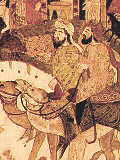 Points Illustrated
1. The Persian lyric: difficulties in rendering its gnomic lyricism.
2. Retaining word repetition.
The Cloud Rains: Previous Versions
The only Internet version I can find is this snippet of translation by the late doyenne of Sufi studies, Annemarie Schimmel: {3}
The cloud weeps, and I become separated from my friend -
How
can I separate my heart from my heart’s friend on such a day.
The cloud weeping – and I and the friend standing, bidding farewell
-
I
weeping separately, the clouds separately, the friend separately.
. .
 Word-For-Word
Rendering
Word-For-Word
Rendering
We start with the Persian text provided by Wheeler Thackston, {4} for whom the piece 'exhibits his lyric side at its loveliest':

And then undertake a word-for-word translation:
1a. abr | mībārad | va | man | mīshavam | az | yār | judā | ||
cloud | raining | u | I | become | from | friend | separated | ||
1b. chun | konam | dil | bachanin | rōz | z | dildar | judā | ? | |
how | I make | heart | such a | day | from | in heart | separated | ? | |
2a. abr | u | bārān | u | man | va | yār | sitādah | ba | vidā'a |
cloud | and | rain | and | I | and | friend | stood | for | farewell |
2b. man | judā | girya | konān | abr | judā | tū | judā | ||
I | separated | tear- | is making (weeping) | cloud | separated | you | separated | ||
3a. sabzah | naw | khźz | u | havā | khurram | u | bustān | sar | sabz |
verdure | new | risen | and | love passion romance | fresh joyful | and | garden | head | verdant |
3b. bulbul | rōy | siyāh | māndah | z | gūzar | judā | |||
nightingale | (face) | (overcast) disgraced | remained | from | place path | separated | |||
4a. az | murādar | tah | har | mūy | z | zulfat | bandī | ||
from | in desire longing | root | every | hair | from | tresses | of servant slave fastening | ||
4b. chah | konī | band | z | bandam | hamah | yakbār | judā | ? | |
what how | do you | - from | limb | to limb | the whole | all at once | separated | ? | |
5a. dīdh | az | bahar | tū | khūnābar | shod | ay | mardam chashm | ||
(seen-) | from/ than | for/ to every | you | (raining blood) tears | (-becomes/ became) | O | pupil of the eye | ||
5b. mardumī | kon | mushav | az | dīdah | khūnābar | judā | |||
manliness generosity courtesy | do | be not | from | sight eye vision | (raining blood) tears | separated | |||
6a. ni'mat | dīdah | nakhūham | ki | bamānd | pas | azīn | |||
ease luxury | sight eye vision | very pride | that | stayed (they) | after then | such as this, from this | |||
6b. mandah | chun | dīdah | izan | ni'mat | dīdār | judā | |||
remained | when if how since | sight eye vision | from him thence | ease luxury favour | vision rendezvous | separated | |||
7a. dīdah | sad | rakhna | shod | az bahr | tū | khākī | |||
sight eye vision | hundred | chink window crack breach | became | for sake of | you | made of dust earthling | |||
z | rahat | zūd | bargīr | u | bekon | rakhna | dīdār | judā | |
from | escaped liberated * | haste- | accept take | and | -make | chink breach window | vision rendezvous | separated | |
8a. maid | ham | jān | ma rav | az | man | vagarat | bāvar | nīst | |
remain | also so | life soul | go not | from | I me | and if although | belief, to believe | is not | |
bźsh | azan | khwāhahiī | bustān | u | nigahdār | judā | ? | ||
more | from that | willy nilly | garden | and | guardian | separated | ? | ||
9a. husn | tū | dźr | napīd | chū | z | khusraw | rufti | ||
beauty | you | late long | not stand firm | when if | from | Khusraw | you go | ||
gul | basī | dźr | namand | chū | shod | az | khār | judā | |
flower | many a | long | not remain | when if | became | from | thorn thistle | separated |
To chase up any missing izāfa, etc. we have to construct a metric table as before. The first line of the poem runs:
| 'ab | rė | mī | bā | ra | du | man | mī | sha | va | maz | yā | rė | ju | dā | |
| - | x | - | - / | x | x | - | - / x | x | - | - / | x | x | - |
and the metre (for those who wish to know such things) is ramal sālim makhbūn mahzūf. The exercise allows us to set out the word-for-word rendering as:
1. Cloud raining and I from friend become separated
how I make
heart such a day from in heart separated?
2. Cloud and rain and I and friend stood for farewell
I separated
weeping cloud separated you separated
3. Verdure new risen and passion fresh and garden head green
nightingale
disgraced remained from place separated.
4. From longing of root every hair from tresses of servant/fastening
how do you
from limb to limb the whole all at once separated?
5. Seen that from every you tearfulness becomes O pupil of the eye
manliness
do be not from vision/sight tearfulness separated.
6. Luxury of sight very pride that stayed after such as this
remained
if sight from him ease of vision separated.
7. Eye of hundred chinks for sake of you became as dust
from liberated
accept and make haste chinks vision separated.
8. Remain so soul not go from me although belief is not
more from
that willy nilly garden and guardian separated.
9. Beauty of you long not stand firm if from Khusraw you go
flower many
a long not remain if from thorn separated.
There are still a few conundrums (and no doubt some errors) but the sense can now be set out roughly as:
1. Cloud raining and I from friend become separated,
how on such
a day can heart from heart be separated?
2. Cloud and rain and I and friend are farewell-taking
I separated,
weeping, cloud separated,you separated.
3. The leaves are new risen, passion is fresh, and the garden green:
(but) nightingale
is disgraced and stays from the place separated.
4. In longing from root to tresses is the hair so fastened:
how can
the whole of it at once then be separated?
5. You are held in my tearfulness as the pupil of vision,
would it
manly to be from that tearfulness separated.
6. My pride in so looking that stays on from this
remains
if from luxury of looking I am separated.
7. From you in its hundred conceptions the eye is of dust
make haste
if not from its acceptance to be separated.
8. Whatever you think my soul will not leave
for all
that garden and guardian be separated.
9. Will your beauty last if from Khusraw you go
more than
the flower live long if from its thorn separated.
Fair
Copy
Now we turn to the form and ask if we should repeat separated. Annemarie Schimmel avoids doing so with a free verse rendering, beautiful in its way, and many translators would follow. The rules in fact require an aa ba ca etc. rhyme scheme but not the word repetition. Rhyme even has advantages:
The nightingale is gone, disgraced, and in the garden
now love
and freshness are both heavily weighted.
But the effect is not the same. I'd suggest we keep the separated, varying the phrasing so that we have something that is not a typically European, but more shifting and syllable-dependent:
Cloud raining, and I from my friend am separated:
how can,
on such a day, the hearts be so separated?
You and rain and cloud are standing to make farewells
and I weeping,
and you and the rain separated.
Though leaves are new risen, passion is fresh, and the garden green,
the nightingale
is silent, from its sanctuary separated.
As the hair grows, from root to head-top, I am bound in service:
how can all that
longing suddenly be separated?
Let not, when tearfulness holds you in the pupil of vision,
my eye
from that tearfulness be separated.
My pride in observance that stays on from this
retains
its luxury of looking though so separated.
In its hundred conceptions the eye is of dust
make haste
if you'd not from acceptance be separated.
What would you think, that my soul would leave
with the
guardian and garden then so separated?
Nor will your beauty continue if from Khusraw kept
as a flower
from its thorn when so separated.
Difficulties
A few lines are perplexing, notably 5, 6 and 7.
Word-for-word, line 5 runs:
Seen that from every you tearfulness becomes O pupil of the eye
manliness
do be not from vision/sight tearfulness separated.
mardumī, not given in Thackston's useful vocabulary, means a host of things: manliness, generosity, courtesy, etc. But the text may simply read mard (man) plus the participle mī (continuing). Only then the hemistich is even more perplexing, with mī not referring to anything. I have avoided the problem with a 'general' interpretation.
Let not, when tearfulness holds you in the pupil of vision,
my eye from
that tearfulness be separated.
Literally, line 6 runs:
Luxury of sight very pride that stayed after such as this
remained
if sight from him ease of vision separated.
In fact the original for 'luxury' and 'ease' is the same — ni'mat — so that the fair copy above:
My pride in so looking that stays on from this
retains
its luxury of looking though so separated.
could also be rendered as:
Whatever of pride or happiness stays on from this
is retained
though the seeing of him is so separated.
But then we have to specify him or her. Ghazals are addressed to a male lover, generally, and that causes problems with a western audience.
Now that puzzling word rakhna in line 7. It means a breach in the wall, a fracture, a notch on a sword or knife, a hole, chink, or window. And paper, according to Steingass. The similar word rakh also means cleft or chink, but adds sigh, grief and disease. More importantly, rukh kardan (and kardan we have in the line, though apparently applying to zud: make haste) means to turn the face towards, to travel to, to come. What then? Experiments with 'windows', 'chinks' and 'crevices' seem not to give acceptable lines, and I have therefore fallen back on 'conceptions', a nondescript expedient. An alternative would be:
For all its hundred notches the eye is of dust
make haste
if you'd not from acceptance be separated.
But 'notch' does not sit happily with 'eye'. We could substitute 'successes', but we are then making a more positive interpretation than seems warranted.
And 'acceptances', where is that in the original?
Eye of hundred chinks for sake of you became as dust
from liberated
accept and make haste chinks vision separated.
I have extended 'accepted' through the hemistich. As before, a general meaning has been hazarded for difficult passages, and that meaning expressed with as many of the original words as possible. A dangerous strategy, of course, but either my basic Persian has missed the meaning, or that meaning is not extractable in any prose sense, when it's the usual word-play of Islamic poetry at work. Feedback would be helpful.
A. Z. Foreman has helped out, {16} and the line is then (rather loosely) translated as:
For you the eye has become as a hundred chinked,
make haste
if you'd not from acceptance be separated.
Notes
and References
1. Amir Khusrau Website. Yousuf Saeed. Oct. 2005. http://www.angelfire.com/sd/urdumedia/index.html.
Very useful site with biography, translations and resources.
2. The Great Turk Genius Amir Khusraw and his Accomplishments in Music.
N.A. Baloch. Jul. 2005. http://muslimheritage.com/topics/default.cfm?TaxonomyTypeID=13&TaxonomySubTypeID=-1&TaxonomyThirdLevelID=-1&ArticleID=526.
Extended article.
3. Amir Khusro. http://oldpoetry.com/authors/Amir%20Khusro NNA. Biography
and short translations by several hands.
4. Wheeler M. Thackston, A Millenium of Classical Persian Poetry: A Guide
to the Reading and Understanding of Persian Poetry from the Tenth to the
Twentieth Century (Iranbooks, 1994).
4. Amir Khusraw and the Genre of Historical Narratives in Verse.
Sunil Sharma. 2002. http://www.cssaame.ilstu.edu/issues/22/sharma.pdf NNA.
Scholarly article with much background information.
5. Persian and Indo-Persian background material for Urdu literature.
Frances Pritchett. Oct. 2005. http://www.columbia.edu/itc/mealac/pritchett/00urduhindilinks/hu_persian_lit.html
Short but useful listing of resources.
6. Persian/English/Persian dictionaries. http://persian.dictionary.kamous.com/translator/reference.asp/.
Several online dictionaries listed.
7. Online English - Persian Dictionary. http://www.math.columbia.edu/~safari/masood/cgi-bin/.
Input as transcribed English letters: larger database.
8. Digital Dictionaries of South Asia. http://dsal.uchicago.edu/dictionaries/steingass/.
Steingass online: includes literary Persian and common Arabic words: fascinating
but more cumbersome to use.
9. F. Steingass, A Comprehensive Persian-English Dictionary: Being Johnson
and Richardson's Persian, Arabic and English dictionary. Revised, enlarged
and entirely reconstructed by F. Steingass (Asian Educational Services,
2003 )
10. E.H. Palmer, Simplified Grammar of Arabic, Persian and Hindustani
(Dover, 1890/2002)
11. A.K.S. Lambton, Persian Grammar Including Key (CUP, 1953, 1979)
12. Easy Persian. http://www.easypersian.com/persian/New/Farsi_Lessons.htm.
75 free lessons: basic but a good place to start.
13. Persian grammar sketch. John Roberts. Aug. 2005. http://lingweb.eva.mpg.de/fieldtools/pdf/PersianGrammarSketch.pdf
NNA. 85 page introduction: free and helpful, but linguistic/formal approach.
14. Amir Khusro. http://oldpoetry.com/authors/Amir%20Khusro NNA. Biography
and short translations by several hands.
15. Amir Khusrau: Bibliography. http://www.angelfire.com/sd/urdumedia/biblio.html.
Good listing but to offline material.
16. Email to me from Alex Foreman: 2 March 2012. Part of the problem is
that the text you're using has a typo. The hemistich should end with "divar"
not "didar." It probably isn't the latter since the line immediately previous
already ends in "didar juda". Repeating one line's end-rhyme in the very
next line-end is rather unusual. Presumably if it is indeed didar, then
the reference is to the blotches in one's vision caused by tears. This is
stretching it, but totally possible as an image back there and back then.
Otherwise, the "rakhna-yi didar" are "chinks/cracks in the wall." For some
reason you have "rahat" glossed as "liberated/escape." I do not know why.
It is actually short for "rah-at" i.e. "thy road." Now as for the other
instance of "rakhna" the idea is that the eye has developed a hundred chinks
through which to weep tears (whether they consist of blood or regular lachrymal
fluid or both.) These are, it would seem, being elliptically linked to the
cracks in a wall. The line actually reads Dida sad-rakhna shud az bahr-i
to, khaki zi rah-at Zud bar-gir u bikun rakhna-yi divar juda "The eye has
become hundred-chinked on your account, take thou with haste the dusty(lowly)
one from thy road and set the crack(s) in the wall at a distance. "
The final version is included in Diversions, a free pdf collection of translations published by Ocaso Press.
A 568-page free pdf ebook on practical verse writing is available from Ocaso Press. Click here for the download page.
Material can be freely used for non-commercial purposes if cited in the usual way.