TRANSLATING AMIR KHUSRAW 1
 Points Illustrated
1. More on Persian prosody.
2. Choosing the right rhyme word.
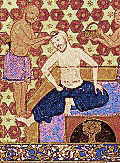
Abu'l-Hasan Yamînuddin Amîr Khusraw
Amîr Khusraw (1253-1325) was born in the village of Patyali (Uttar Pradesh) to an Indian mother and a Turkish military nobleman. {1} His father had fled Transoxiana before the Mongol advance to serve the Delhi Sultans, but he died in 1262, leaving the son in the care of a rich maternal grandfather. The boy studied Persian at Maktab and produced his first collection of poetry "Tuhfatus-Sighr" in 1272. Thereafter Khusraw served as court poet to a succession of Delhi Sultans, from Balban to Mohammad bin Tughlaq, creating five divans and much occasional writing. He was also a soldier (captured by and escaping from the Mongols in 1285) and a gifted musician (laying the foundations for Indo-Muslim music and inventing several new instruments). {2}
Called the "parrot of India", Amîr Khusraw was an extraordinarily fluent and voluminous writer, producing nearly half a million verses that included re-interpreted Persian classics and exquisite lyrics of his own. The Timurids of Herat and the Mughal Emperors especially prized his work, and his children's riddles are still popular in India.
 Original
Amîr Khusraw is not much translated, but there is a pleasing rendering by Hadi Hasan: the first five lines run: {1}
O you whose beautiful face is the envy of the idols of Azar
You remain superior to my praise.
All over the world have I traveled;
many a maiden’s love have I tasted;
Many a beauty-star have I seen; but you are something unique.
Word-For-Word
Rendering
We undertake a word-for-word translation, using dictionaries {6} {7} {8} {9} and grammars as necessary: {10} {11} {12} Thackston's book provides the Farsi text, {3} which I have taken as correct ( Hasan's seems a shortened version.)

Ay | chihra | zêbâ | tû | rashk | butan | azarî | |||
1. O | face | beauty | you | jealousy | idols | azar | |||
har | chand | vasfat | mîkonam | dar | husn | az | ân | zebatrî | |
every | how much | descriptions | I make | in | beauty | from | that | much more adorning | |
2. hargaz | niyâyid | dar | nazar | naqshi | z | ru'yat | khûbatar | ||
ever | ? you blessed | in | sight | picture | from | vision | more beautiful | ||
hûri | nadânam | ay | pesar | farzand | âdam | ya | parî | ||
houri | I not know | O | boy son | child son | Adam | unless | fairy | ||
3. âfaq | ra | gar | dîdaham | mihr | butan | varzîdaham | |||
horizon | (obj) | if | I see | love affection | idols | I experience try out | |||
bisyâr | khuban | dîdaham | âmâ | tû | chîz | dîgari | |||
many | beauties | I see | but | you | thing | other | |||
4. Ay | râhat | u | âram | jân | bâ | qadd | chûn | sarvi | ravân |
O | ease comfort | and | rest repose | life soul | not with-standing | tall- | how | -and elegant (cypress) | flowing /soul |
zînsân | marv/ ma rav | dâman | kashân | kâram | jânam | mîburî | |||
from this manner | go not | skirt - | pull in (avoid) | deed task | with my life |
you escape | |||
5. azm | tamâshâ - | kardah | âhang | sabrâ | kardah | ||||
determination | spectacle | made | outset | waited | have | ||||
jân | u | dil | mâ | înast | rusam | dâbarî | |||
life soul | and | heart | which whilst as long as | this is | custom | pomp | |||
6. âlam | hame | yaghmâi | tû | khâliqî | hame | shayad | ay | tû | |
world universe | all/ assault | very plunder | you | very creator | all/assault | perhaps/fitting | O | you | |
ân | nargis | ra'nâî | tû | âvurdah | kêsh | kâfirî | |||
that the former, moment | narcisus | freshness loveliness | you | professed | a religion | infidelity | |||
7. Khusrau | gharîb | ast | u | gadâ | âftâdah | dar | shehr | shomâ | |
Khusrau | humble, stranger | is | and | beggar | befallen | in | city | you | |
bâshad | ki | az | bahr | khuda | suyi | gharîban | bangarî | ||
Would that it were/ ought to have | who | for | sake of | lord, God | towards/ direction | poor humble | for another | ||
We now need to look at the verse structure.
Persian
Metre
Why, when it's so complicated, should we bother with Persian prosody? Well, apart from the aesthetics, the pleasure of reading the poem properly, the sense often cannot be safely established without the scansion. There are three reasons for this. Firstly, the normal word order is often inverted. Secondly, the possesive izâfa, the unwritten i syllable is counted in the scansion, which tells us what refers to what. And thirdly, because the short vowels are not commonly shown, the same word as written can have different pronunciations and meanings, most particularly with verbs. In short, the word-for-word approach of the previous tables breaks down, and we can imagine ambiguities or meanings that do not exist.
A very brief summary of prosody follows, I hope sufficient to explain the table below. Readers who want more are referred to Wheeler Thackston's excellent treatment, from which these notes are taken. {3}
1. The sh ch kh etc. consonants count as one consonant. Likewise w and y in the diphthongs aw and ay. The n plus another consonant is counted as one consonant.
2. The a i and u vowels are short. The â î ê ô and û vowels are long.
3. The word-ending a and the final u in tu or chu etc. can be long or short as the metre demands. The same flexibility applies to the izâfa, and to the unemphasized a and u following words (enclictics).
4. The initial glottal stop ('a) may be elided or attach itself to the last consonant of the proceeding word and be counted as a full syllable. Glottal stops within words, or between vowels, are not elided.
5. Several syllables may be contracted, eg. vâv to v, vagar to var, dîegar to digar, buguzarîn to bugzarîn, ki to k, ki-at to kat, pidar-ash to pidar'sh, a-a to a, the final âh to ah, and khvâst to khâst. Rhyme can cause the last to be 'heard' as a double syllable when the st is followed by a short vowel.
6. Persian metres are patterns of long and short elements. The short element is a consonant followed by a short vowel: Cv. The long elements may be a consonant followed by a long vowel (CV) or consonant followed by short vowel followed by consonant CvC.
7. Anomalous elements not conforming to CV, CV or Cvc have to 'resolved' or treated in the following ways.
a. With CVC or CvCC, the last C is attached the vowel of the following word, or (where the following word starts with a consonant) an extra syllable is intoduced (nîm-fatha, ë, unpronounced but sensed in the reading). Dast becomes das-të and dâd becomes dâ-dë.
b. With CVCC, the last C is attached to the initial vowel of the following word: CVCC v becomes CVC Cv, and the penultimate C becomes Cë with a nîm-fatha. The CVCC word then reads CV Cë CV If no vowel follows, however, the nîm-fatha is added and the anomalous CVC simply treated as a long element: CVCC becomes CVC Cë.
c. An overlong syllable at the end of a hemistich is not resolved (but simply indicated as ±).
8. Some 70 metres exist, all patterns of the three elements CV, CV and Cvc
Two final points. Lines are stand-alone independent entities in the ghazal or qasida. Poems therefore seem somewhat artificial, a series of short statements held together by form, meter and rhyme rather than by clauses or binding emotion. Secondly, Persian poetry was intensely conservative, even stereotyped, seeking refinement of existing convention more than innovation. Craftsmanship was emphasized, and its poets read and memorized thousands of lines before venturing to write their own. Our rendering has to reflect these matters.
Idols
of Azar
Wheeler Thackston gives us the scansion for this poem. The first line runs:
| 'ay | chih | ra | yi | zê | ba | yi | tu | rash | ki | bu | tâ | ni | 'a | za | rî |
| - | - | x | - / | - | - | x | - / | - | - | x | - | - | x | - |
A decent grammar book {11} tells us which syllables are intrinsically stressed in Persian (the italics in the line above shows where these syllables may be both stressed or unstressed).
The name of the metre ( in fact rajaz sâlim) doesn't matter, but we can use it to correct any uncertainty or missed izâfa because a. the metre has to be kept to, and b. pairs of hemistichs must have the same number of syllables. So:
| 1. 'ay | chih | ra | yi | zê | bâ | yi | tu | rash | ki | bu | tâ | ni | 'a | za | rî |
| - | - | x | - / | - | - | x | - / | - | - | x | - / | - | - | x | - |
| har | chand | iv | as | far | mi | ku | nam | dar | hus | na | zân | ze | ba | ta | rî |
| 2. har | gaz | ny | âd | id | dar | na | zar | naq | shi | az | ru | 'at | khû | ba | tar |
| hû | ri | na | dân | am | ay | pe | sar | far | zan | di | âd | am | ya | pa | rî |
| 3. âf | aq | ra | ga | ri | dî | da | ham | mih | ri | bu | tan | war | zî | da | ham |
| bis | yâr | khu | ban | dî | da | ha | mâ | mâ | tû | chîz | chî | zi | dî | ga | ri |
| 4. ay | râh | at | u | â | ram | jân | bâ | qa | di | chû | ni | sar | vi | ra | vân |
| zîn | sân | ma | ra | vë | dâ | man | ka | shân | kâr | am | jâ | na | mî | bu | rî |
| 5. azm | ta | mâ | shâ | shâ | kar | dah | âh | ang | sab | râ | kar | dah | |||
| jân | u | di | lë | mâ | în | ast | ru | sa | mi | dâ | ba | rî | |||
| 6. âl | am | ha | me | yagh | mâi | tû | khâ | liq | qî | ha | me | sha | yad | ay | tû |
| a | ni | nar | gi | si | ra | nai | tu | av | ar | dah | ke | shi | ka | fi | ri |
| 7. Khus | rau | gha | rî | bast | u | ga | dâ | âf | tâ | dah | sheh | ri | sho | mâ | |
| bâ | shad | kaz | bah | re | khu | da | su | yi | ghar | rî | ban | ban | ga | rî | |
We have found a few izâfas, and see that marv in line 4b is not the city Merv but the negative imperative of raftan: do not go. We start with a word-for-word rendering:
1. O face of beauty you jealousy of idols of Azar
every many descriptions I make in beauty from that much more adorning
2. Ever you blessed in sight picture from vision more beautiful
houri I do not know O youth son of Adam unless a fairy
3. Horizon if I see love of idols I experience
many beauties I see but you thing other
4. O ease and rest life notwithstanding tall and how elegant flowing
from this manner go not avoid task of my life you escape with
5. Determination spectacle made outset waited have
life and heart as long as this is custom of pomp
6. Universe all very plunder you very creator fitting O you
that narcissus of freshness you professed a religion of infidelity
7. Khusraw humble is and beggar befallen in city of you
ought to have who for the sake of God towards humble for another
A literal, semi-prose rendering might be:
1. You whose face makes jealous the idols of Azar
Whatever description I make your beauty exceeds.
2. You are a picture from a vision, unreal
and beautiful to sons of Adam as are the houris.
3. If I scour the horizon I see many beauties
and have known them: you are something different.
4. Continue in this manner, be my life-task, moving gracefully,
my ease and rest that you escape with notwithstanding.
5. From the outset my heart and life have been set,
a spectacle but as the custom is to splendour
6. You create the very universe you plunder, make
of narcissus freshness a faith in infidelity.
7. Khusraw is humble, fallen a beggar in your city:
for the sake of God you should be humble to another.
Translation
If we want to keep the 'singing' quality, and the aa ba ca da ea fa ga rhyme scheme, then Azar, Abraham's father and famous crafter of idols, suggests one possibility.
How envious of you are the idols of Azar
whose
face of loveliness my words will mar.
To Adam's son above him as the houris
repaint
your looks in each particular.
Lost in mirages I ranged horizons,
but
in all there looked on nothing similar.
You are my life and life task, though your moving
take
me from contentment, rest and far.
From the outset patient, ever faithful,
your
splendour following as evening star.
Why does the fresh flower of the world you plunder
stay
not faithful to me, singular?
A stranger in your city, Khusraw pleads
for God and
pity, as his poor words are.
But that's a little contrived, and not close to the literal meaning. We'd do better with the 'face' rhyme:
Envious are Azar's idols of a face
beyond
all artistry of mine to trace.
You are a picture from a vision, real
to
men of Adam as our houri race.
For idols I have travelled wide horizons,
but met,
in much encountered, no such case.
From me go peace and comfort: you continue
the
more in elegance and moving grace.
From your high splendour my life is set, falling
and
following, as is the custom, you apace.
Let not the flower's white freshness you depict
by
faithlessness be pillaged, or disgrace.
Fallen, a stranger in your city, Kushraw begs
for the
sake of God you know another's place.
Notes
and References
1. Amir Khusrau Website. Yousuf Saeed. Oct. 2005. http://www.angelfire.com/sd/urdumedia/index.html.
Very useful site with biography, translations and resources.
2. The Great Turk Genius Amir Khusraw and his Accomplishments in Music.
N.A. Baloch. Jul. 2005. http://muslimheritage.com/topics/default.cfm?TaxonomyTypeID=13&TaxonomySubTypeID=-1&TaxonomyThirdLevelID=-1&ArticleID=526.
Extended article.
3. Wheeler M. Thackston, A Millenium of Classical Persian Poetry: A
Guide to the Reading and Understanding of Persian Poetry from the Tenth
to the Twentieth Century (Iranbooks, 1994).
4. Amir Khusraw and the Genre of Historical Narratives in Verse.
Sunil Sharma. 2002. http://www.cssaame.ilstu.edu/issues/22/sharma.pdf
NNA. Scholarly article with much background information.
5. Persian and Indo-Persian background material for Urdu literature.
Frances Pritchett. Oct. 2005. http://www.columbia.edu/itc/mealac/pritchett/00urduhindilinks/hu_persian_lit.html
Short but useful listing of resources.
6. Persian/English/Persian dictionaries. http://persian.dictionary.kamous.com/translator/reference.asp/.
Several online dictionaries listed.
7. Online English - Persian Dictionary. http://www.math.columbia.edu/~safari/masood/cgi-bin/.
Input as transcribed English letters: larger database.
8. Digital Dictionaries of South Asia. http://dsal.uchicago.edu/dictionaries/steingass/.
Steingass online: includes literary Persian and common Arabic words: fascinating
but more cumbersome to use.
9. F. Steingass, A Comprehensive Persian-English Dictionary: Being Johnson
and Richardson's Persian, Arabic and English dictionary. Revised, enlarged
and entirely reconstructed by F. Steingass (Asian Educational Services,
2003 )
10. E.H. Palmer, Simplified Grammar of Arabic, Persian and Hindustani
(Dover, 1890/2002)
11. A.K.S. Lambton, Persian Grammar Including Key (CUP, 1953, 1979)
12. Easy Persian. http://www.easypersian.com/persian/New/Farsi_Lessons.htm.
75 free lessons: basic but a good place to start.
13. Persian grammar sketch. John Roberts. Aug. 2005.
http://lingweb.eva.mpg.de/fieldtools/pdf/PersianGrammarSketch.pdf NNA.
85 page introduction: free and helpful, but linguistic/formal approach.
14. Amir Khusro. http://oldpoetry.com/authors/Amir%20Khusro NNA.
Biography and short translations by several hands.
15. Amir Khusrau: Bibliography. http://www.angelfire.com/sd/urdumedia/biblio.html.
References not online.
The final version is included in Diversions, a free pdf collection of translations published by Ocaso Press.
A 568-page free pdf ebook on practical verse writing is available from Ocaso Press. Click here for the download page.
Material can be freely used for non-commercial purposes if cited in the usual way.