TRANSLATING WANG WEI (1)
Points Illustrated
1. Comparing translations.
2. Finding meaning by looking closely at the ideograms.
Wang Wei
Wang Wei (699-761), one of the three great poets of the earlier Tang Dynasty, was born in Shensi, his father a local official and his mother a member of a distinguished literary family. At 16, Wei and a brother were introduced to society in the Tang capital of Chang-an, then the largest city in the world, and at 23 he passed the shin-shih which guaranteed entry into literary and official circles (exams which Du Fu failed and Li Bai never deigned to sit).
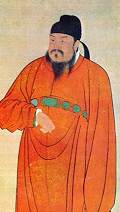 |
A man of outstanding talents — courtier, administrator, poet, calligrapher, musician and painter — Wang was immediately appointed Assistant Secretary for Music, which he seems to have found irksome. After a minor indiscretion, was exiled to the provinces in Shantung, where he remained some years before resigning and returning to Chang-an. He married and set about developing an estate in the Changnan hills south of the capital, to which he returned whenever possible. When Wang was 30 his wife died, and the poet did not remarry but returned to Government service, dividing his time between Changnan and various missions, including three years on the northwest frontier. In 750 AD, when his mother died, Wang retired to write and paint and meditate in his beloved Changnan.
Far more than the mercurial Li Bai or the plain-spoken Du Fu, Wang Wei was a successful official — he amassed several fortunes and gave lavishly to monasteries — but he too was caught up in the 755-9 An Lushan rebellion. Captured by rebels, Wang was obliged to collaborate, for which he was briefly imprisoned when imperial order was restored. But always valuable, Wang returned to Government service and belonged to the Council of State when he died in 761.
Modest, supremely gifted but detached from life, Wang was the model scholar official, and his 400 poems are in many anthologies. An enormous quantity of poetry was written throughout the Tang period, and its greatest exponents illustrate the three fundamental strands of Chinese thought: Confucianism, Taoism and Buddhism. Wang Wei was a Buddhist mystic, viewing the world with a detached compassion. Life is an illusion, and its ensnaring passions and appetites keep us from our better natures — the more so in the sophisticated court life of the Tang where Chinese culture reached its apogee. All three poets were ambivalent towards its refined charms, particularly during the corrupting last years of Taizong's rule, though also bitterly sad at its destruction by the An Lushan rebels. Li Bai's membership of the celebrated Han-lin Academy lasted only two years, Du Fu never held more than minor posts, and even the courtly Wang Wei was happiest in the Changnan or in quiet monastery settings. {1}
 Previous
Translations
Previous
Translations
Wang Wei's Deer Park may be the most translated of all Chinese poems. Sixteen versions of the poem (seventeen with Octavio Paz's second attempt) are conveniently collected in a little book by Eliot Weinberger, {2} and there are also translations in books by Arthur Sze, {3} Vikram Seth {4} and others. Versions by Tony Kline, {5} Arthur Sze, {6} David Hinton, {7} Jerry M. Spiller, {8} Howard H. Landman {9} and Stephen Owen {10} can be found on the Internet.
To see what translators have worked from, here is the literal word-for-word rendering as usually given: {11}
Empty mountain not see people
Only hear people talk sound
Return brightness enter deep forest
Again shine green moss upon.
Because so many versions exist, it may be helpful to have a tabular comparison, possibly under a fidelity to the sense as far as we can divine it, and then effectiveness as a poem. Breaking these headings down further, we might draw up these criteria:
Textural accuracy
-
nothing omitted
-
nothing added
-
sense: the translator has divined something worth saying beyond the bald meaning of the words
-
coherence: the poem hangs together
Effective rendering
-
concision: poem is very concise and we'd expect the translation to be the same
-
appropriate diction, calling up the right associations and responses
-
rhythmic control: sufficient to give the words placing and significance
-
felicity: whether the translation appeals to us as a poem, having something to impart
Below is my personal assessment of previous translations,
| translator and date |
lang
|
textural fidelity
|
effective
rendering
|
total
|
|||||||
|
omissions
|
additions
|
sense
|
coherence
|
concision
|
diction
|
rhythm
|
felicity
|
||||
| 1 | Fletcher 1919 |
eng
|
4
|
3
|
2
|
4
|
3
|
3
|
4
|
3
|
28
|
| 2 | Brynner & Kiang 1929 |
eng
|
3
|
4
|
2
|
4
|
4
|
4
|
3
|
2
|
26
|
| 3 | Jenyns 1944 |
eng
|
4
|
3
|
2
|
4
|
4
|
4
|
4
|
3
|
24
|
| 4 | Margouliès 1948 |
fren
|
4
|
3
|
2
|
4
|
4
|
3
|
4
|
4
|
28
|
| 5 | Chang & Walmsley 1958 |
eng
|
3
|
3
|
2
|
4
|
4
|
3
|
4
|
3
|
26
|
| 6 | Chen & Bullock 1960 |
eng
|
4
|
2
|
2
|
4
|
3
|
4
|
4
|
3
|
26
|
| 7 | Liu 1962 |
eng
|
3
|
2
|
2
|
4
|
4
|
3
|
3
|
3
|
24
|
| 8 | Rexroth 1970 |
eng
|
3
|
1
|
2
|
4
|
1
|
3
|
4
|
3
|
21
|
| 9 | Watson 1971 |
eng
|
4
|
4
|
3
|
4
|
4
|
4
|
3
|
3
|
29
|
| 10 | Yip 1972 |
eng
|
3
|
4
|
2
|
4
|
4
|
4
|
3
|
2
|
26
|
| 11 | Robinson 1973 |
eng
|
3
|
4
|
3
|
3
|
4
|
3
|
3
|
2
|
25
|
| 12 | Paz 1974 |
span
|
3
|
3
|
2
|
4
|
4
|
4
|
4
|
4
|
28
|
| 13 | McNaughton 1974 |
eng
|
3
|
3
|
3
|
3
|
3
|
3
|
4
|
3
|
25
|
| 14 | Cheng 1977 |
fren
|
3
|
2
|
1
|
3
|
4
|
4
|
3
|
3
|
23
|
| 15 | Chang 1977 |
eng
|
3
|
2
|
2
|
4
|
4
|
3
|
2
|
2
|
22
|
| 16 | Snyder 1978 |
eng
|
4
|
4
|
3
|
1
|
4
|
4
|
3
|
2
|
25
|
| 17 | Paz 1978 |
span
|
4
|
4
|
3
|
4
|
4
|
4
|
3
|
3
|
29
|
| 18 | Kline 2000 |
eng
|
3
|
3
|
2
|
4
|
4
|
4
|
3
|
3
|
26
|
| 19 | Sze 2005 |
eng
|
4
|
3
|
3
|
1
|
4
|
4
|
2
|
2
|
23
|
| 20 | Hinton 2005 |
eng
|
4
|
3
|
3
|
2
|
4
|
4
|
4
|
4
|
28
|
| 21 | Spiller 2005 |
eng
|
3
|
3
|
2
|
1
|
4
|
4
|
3
|
2
|
22
|
| 22 | Landman 1997 |
eng
|
3
|
2
|
1
|
2
|
4
|
3
|
2
|
2
|
19
|
| 23 | Owen 1997 |
eng
|
4
|
3
|
1
|
3
|
3
|
3
|
2
|
2
|
21
|
First
Rendering
If we want something like the previous versions, but keeping more to the original form we could write:
An empty mountain. No one seen,
but heard is someone talking here.
The sun re-enters forest depths;
green lights on mosses reappear.
Exactly five words to the line. Rhyme scheme carried over. 'Again shine' is conveyed as 'lights' and 'reappear'. Otherwise nothing is added or omitted. Result? Generally neither better nor worse than previous versions, but no more of a poem either.
Octavio Paz makes several points: "The poems of Cathay (1915) were written in an energetic language and in irregular verses which I have rather loosely labeled as free. In fact, although they do not have a fixed measure, each one of them is a verbal unity. Nothing could be more remote from the prose chopped into short lines that today passes for free verse. . . At the beginning I used free verse; later I tried to adjust myself to a fixed rule, without of course attempting to reproduce Chinese meter. In general, I have endeavored to retain the number of lines of each poem, not to scorn assonance and to respect, as much as possible, the parallelism. This last element is central to Chinese poetry, but neither Pound nor Waley gave it the attention it deserves. Nor do the other translators in English. It is a serious omission . . . because parallelism is the nucleus of the best Chinese poets and philosophers: the ying and the yang. The unity that splits into duality to unite and divide again. . . I decided to use a line of nine syllables. . . not only because of its greater amplitude but also because it appeared to be, without actually being, a truncated hendecasyllable. It is the least traditional of our meters and it appears infrequently in Spanish poetry, except among the "modernists" — above all Rubén Darío — who used it a great deal. I also decided to use assontal rhyme, but unlike the Chinese I rhymed all four lines. . ." {12}
In short, the structure matters. We won't make poetry without it, and we won't achieve a good translation unless that structure also meshes with the Chinese words in their larger meanings.
Word
for Word Translation
Using a Pinyin version, {13} looking words up in an online dictionary, {14} and checking with the ideograms given in Eliot Weinberger's book, we get:
| lu4 | zhai4 | |||
| deer; surname; radical no. 198 | firewood, faggots, fuel | |||
| kong1 | shan1 | bu4 | jian4 | ren2 |
| empty, hollow, bare, deserted | mountain, hill, peak | no, not; un-; negative prefix | see, observe, behold; perceive | man; person, people; mankind; someone else |
| dan4 | wen2 | ren2 | yu3 | xiang3 |
| only; but, however, yet, still | hear; smell; make known; news | man; person, people; mankind; someone else | language, words; saying, express | make sound, make noise; sound |
| fan3 | jing3 | (ying) ru4 | shen1 | lin2 |
| return, revert to, restore | scenery, view; conditions | enter, come in(to), join | deep; depth; far; very, extreme | forest, grove; surname |
| fu4 | zhao4 | qing1 | tai2 | shang4 |
| return; repeat; repeatedly | shine, illumine, reflect | blue, green, black; young | moss, lichen | top; superior, highest; go up, send up |
Chinese is a language governed by tradition, and meanings are not necessarily given by word-for-word pinyin translations. Nonetheless, meaning is rather more complex than previous versions suggest.
Buddhist
Themes
Wang Wei's Buddhist leanings are well-known, and many translators have entitled the poem 'Deer Park', drawing a parallel with the deer park at Sarnath where the Buddha preached his first sermon. The pinyin, however, reads 'deer firewood', as do the ideograms. If we look further at the second ideogram, we see the radical for tree and the character cï, meaning 'stop and turn around'. {15} 'Stockade', in other words. 'Deer Stockade' or 'Deer Enclosure' is the correct title. We can argue that enclosure is a sort of park, but I suspect Wang Wei would have simple written 'park', a different ideogram, if the reference had been important. The title is probably a place name, carrying overtones of deer and woods, both denoting refuge in Chinese.
The second reference to Buddhism is fan jing in line 3, which many translators read as late sun or westering sun. The pinyin reads 'return view', but the ideograms say something subtly different — 'movement in reverse' {16} and 'sun above hill'. {17} Hence sunset, which was a conventional trope in Tang times. But if fan jing refers to the slanting rays of the evening sun, what then is meant by the 'again' of the following line? That the sun has again broken through a cloudy day at evening to illuminate mosses high in the trees, itself a metaphor for repeated enlightenment? Possibly, and one which Octavio Paz develops in his second version. The Pure Land school of Chinese Buddhism did look to a western paradise, {18} {19} {20} and Wang Wei may have had such thoughts in mind. But the association is rather tenuous, and there exist more compelling readings for fan jing, as we shall see. Not all Chinese poets read the characters as 'late sun', incidentally: Marylin Chin renders lines 3 and 4 as: Returning shadows enter deep forest / Again shines green moss/lichen top. {21}
Reference
to Painting
The poem cannot simply be a transcript of experience if we read the last word as something to do with 'looking up'. Normal moss grows on the shadow side of trees, and would not be sunlit. Tree moss can catch the sun, but such moss only grows in humid settings at higher altitudes. There is nothing in the title to suggest such a setting, and Wang Wei himself was not an ascetic but a prosperous courtier with a fondness for parks and monasteries. Such terrains do appear in landscape painting, however, so that the poem may be an imaginative amalgam of calligraphy and painting: Wang Wei is not recording, but commenting on the painting of a scene, or on painting in general.
Parallelism:
Ying and Yang
Octavio Paz draws attention to the important parallelism in Chinese poetry, and Eliot Weinberger notes that only the distinguished Chinese translator Burton Watson has conveyed this aspect in his translation. If we now look at the first two lines, we find alternating ying and yang: absence (emptiness) presence (mountain) presence clearly not there (no one seen) and presence unclearly there (unlocalized voices). Something similar should operate in the concluding two lines, which is indeed the case if we examine the ideograms of the more perplexing words:
Line 3: character fan means 'movement in reverse' {16}
Line 3: character jin means 'sun above hill' — bright as an adjective, view: scene or scenery when used as a noun. {17}
Line 4: character zhao means apparent, by light of fire — illuminate when used as a verb. {22}
Line 4: character qing is built of the pictograph of an object rising through the earth (soil, dirt, ground) plus the pictograph of the crescent moon, the two indicating the colour of lush growth, green, blue, young when used as an adjective. {23}
Line 4: character shang means 'above' or 'upper' as an adjective, and 'get on' or 'go up' when used as a verb. {24}
Where does this get us? Possibly a reading along these lines: absence of light (reverse of sun over hill) in unlocalized place (entering forest) returning (fu) apparent (zhao) becoming (qing: rising through earth: green) presence (moss) definite place (shang: overhead). Fan (reverse) applies not only to sunrise but the moss, normally seen on the ground but here overhead.
We can also see a parallelism in direction: mountain (look up) no people, hear voices (look around) entering forest (continue on the level) depth (look down) return (fu) rising through earth (qing) moss above (look up).
These seem far too neat to be accidental, and something similar is operating in the metaphorical use of words: mountain (eminence) see no one (loneliness) but people (company) as voices heard (diminished). Second sentence: sunlight (eminence) entering forest (take refuge) moss (lowly) above (elevated).
Second
Attempts
If these readings are anything like correct, then we don't have to become fixated on individual words in their prose sense, but can render the essence of the poem with the devices that poetry affords. If we want a simple, fairly naturalistic rendering, we'd write:
Empty mountains. No one unless
discerned in the voices overheard.
Late sun entering forest depths
disclosed in green mosses overhead.
If that's regimenting matters too much, then:
Emptiness. Mountains. No one unless
in these low voices overheard.
Sunlight lost in forest depths
but shining green mosses overhead.
Or, to emphasize the monochrome nature of Chinese painting, which Wang Wei is probably commenting on:
Emptiness. Mountains. No one unless
in these dark voices overheard.
Scene falling into forest depths
and daylight in mosses overhead.
Or, rescuing the green:
Emptiness. Mountains. No one unless
in these low voices overheard.
Sense falling into forest depths,
green in suncast mosses overhead.
The points worth noting in the fourth version may be:
1. Use of assontal rhyme or pararhyme: a b a b. We cannot duplicate the features of Chinese verse, but we do need something to make sound and sense interpenetrate.
2. Concision and rightness of phrasing: 5 words and 4/5 stresses to each line.
3. Extended parallelism of the original Chinese. In particular:
a. Lines 3 and 4 repeat in reverse the meaning in lines 1 and 2: the world of the senses is an illusion. 'Overhead' repeats in reverse 'overheard'.
b. Contrast of presence with non-presence: clear in first line, blurred in second, more so in third, and then sharply defined in clear visual image of the fourth. Achieved by sound patterning (e.g. diphthongs in line 2, 'e' sounds in line 3).
c. Ying and yang elements. Permanence of mountain rising from impermanence (emptiness). That definite emptiness (no one) morphing into vague presence (voices). Dissolving again (sense is lost in darkness) and then regrouped in definite image (suncast in mosses).
d. Vertical movement (looking up at mountain) passing to horizontal (voices heard followed by re-entering) and thence back to vertical (overhead).
4. Conjunction of poetry and painting. Chinese landscape painting is largely monochrome (grey or green: the qing of line 4), and Wang Wei's was in the Southern style of discrete details (forest depths, dark moss suncast) and soft washes (emptiness, overheard, entering). {7}
5. Images immediately given — emptiness, mountains . . . suncast in mosses.
Final
Remarks
1. Earlier remarks notwithstanding, the poem can be read along Buddhist lines in 1. the various relationships between se (sensible universe) and kong (empty, suprasensible realm), 2. the Chan notion of sudden enlightenment, and 3. landscapes beyond landscapes. See the extended article by Da'An Pan. {25}
2. This page does not record the actual process of translation but, like a scientific paper, places an orderly face on what was often intuitive and untidy. Like Octavio Paz, my first efforts were in free verse, but the meaning of the original Chinese only became apparent by switching to strict forms, a discipline that asks penetrating questions of the author. Paz also mentions Rubén Darío, the translation of whom I found helpful in developing the assonance employed in these translations.
Notes
and References
1. The T’ang Dynasty and the Tao. A.S. Kline. 2000. http://www.tonykline.co.uk/PITBR/Chinese/AllwaterTang.htm#IX.
Illuminating extended essay.
2. Eliot Weinberger and Octavio Paz. Nineteen Ways of Looking at Wang
Wei: How a Chinese Poem Is Translated. (Asphodel Press, 1987). These,
without the commentaries, can be found online at Wang Wei. Several Translations
of One Poem. http://www.chinapage.com/poem/wangwei/wangwei-trs.html.
(Weinburger's interesting venture belongs to the proselytizing phase of
Modernist free verse. Two examples of many double standards in his commentaries:
1. Chang and Walmsley's version is criticized for adding lonely (original
says empty), jade (original says green — or blue or black or fresh)
and motley patterns (not in the original). Weinberger comments: It is
a classic example of a translator attempting to "improve" on the
original. Such cases are not uncommon, and are the product of the translator's
unspoken contempt for the foreign poet. Response: Chang and Walmsley
rearrange the poem, adding the odd word, in an attempt to make something
that appeals as a poem in English. No doubt the rearrangement is overdone,
but we don't have to impugn an author's motives because we disagree on approach.
'Worse' licences are in fact taken by Modernist versions. Rexroth, for example,
invents whole passages in his translation, and none of the words given here
in italics appears in the original Chinese: Deep in the mountain
wilderness / Where nobody ever comes / Only once
in a great while / Something like the sound of a far-off
voice . . But of this version Weinberger says: It is closest to the spirit,
if not the letter, of the original: the poem Wang might have written had
he been born a 20th century America. Rexroth's great skill. . . Rexroth's
version is not particularly skilled, I'd suggest, and indeed misses important
aspects noted above. 2. Of McNaughton's version Weinberger talks of 'cross'
being added for the rhyme scheme he has imposed on himself, and concludes:
The last line adds 'dark' to fill out the thumpety-thump. Response.
The translation simply reproduces the rhyme scheme already present in the
Chinese. And the dark in Glitter again. . . on the dark green
moss does not create a 'thumpety-thump' rhythm, but a. brings the speaker's
view from lofty mountains with which the poem begins to the solid ground
and b. acts as a slowing device to round off the piece.)
3. Arthur Sze, The Silk Dragon (Copper Canyon Press, 2005) http://www.olympus.net/personal/brewster/PDFs/Sze%20sample.pdf NNA..
4. Vikram Seth, Three Chinese Poets (Penguin, 1992). http://www.indiaclub.com/shop/SearchResults.asp?ProdStock=12811
5. The Deer Enclosure. Translation by Tony Kline. Feb. 2000. http://www.tonykline.co.uk/PITBR/Chinese/AllwaterWangWei.htm.
6. Deer Park. Translation by Arthur Sze in Poetry Currents: Mexico/Southwest.
http://poetry.about.com/library/weekly/museletters/blSWmuse79.htm.
7. Deer Park David Hinton. 2005. ttp://www.wordswithoutborders.org/article.php?lab=Wheel NNA.
Several poems on this Words Without Borders site, with notes and
an example of Chinese landcsape painting.
8. Deer Park. Translated by Jerry M. Spiller. 2005. http://www.unc.edu/~jmspille/wangwei.shtml.
9. Deer Park Cottage. Translated by Howard A. Landman. 1997. http://www.polyamory.org/~howard/Poetry/deer_park.html.
10. Deer Park. Translated by Stephen Owen. 1997. http://www.poetry-chaikhana.com/W/WeiWang/DeerFence.htm
11. Let Wen Shine Forth: The Chinese Poetic Tradition and the English
Composition Course. Shujiang Lu. Fall 2005. http://www.fau.edu/compositionforum/14.2/lu-wen-poetic.html NNA..
Some sensible remarks on Chinese poetry: its outer cosmic order found in
inward contemplation: with a good list of references.
12. Weinberger, 1987, 46-48.
13. Fifty-five T'ang Poem A Text in the Reading and Understanding of
T'ang Poetry, Hugh M. Stimson. http://faculty.virginia.edu/cll/chinese_literature/stimson/FT3.htm NNA.
14. Chinese
Character Dictionary. http://www.mandarintools.com/chardict.html.
15. Rick Harbaugh, Chinese Characters, A Genealogy and Dictionary
(Zhongwen, 1998), 254.
16. Harbaugh, 67
17. Harbaugh, 75
18. Following the Buddha's Footsteps. http://online.sfsu.edu/~rone/Buddhism/footsteps.htm
Introduction to basic teachings.
19. Web Resources for Medieval China. Fall 1997. http://www-learning.berkeley.edu/wciv/ugis55a/readings/medievalchina.html NNA. Course reading guide: not all maintained.
20. The Teachings of Chinese Buddhism. http://villa.lakes.com/cdpatton/Dharma/index.html NNA. Linked series of essays.
21. Deer Park. Literal version by Marylin Chin. Jan. 2002. http://www.wwnorton.com/trade/external/nortonpoets/archive/020100.htm.
One of the Norton Poets Online series.
22. Harbaugh, 114.
23. Harbaugh, 211.
24. Harbaugh, 4
25. Tracing the traceless antelope: Toward an interartistic semiotics of
the Chinese sister arts. College Literature. Da'An Pan. Feb 1996. http://www.looksmarteducation.com/p/articles/mi_qa3709/is_199602/ai_n8739664/pg_5?pi=education.
Extended and somewhat technical article.
Chinese translations: du fu 1 . du fu 2 . li bai 1 . wang wei 1
© C. John Holcombe 2004 2005 2006 2007 2012.
Material can be freely used for non-commercial purposes if cited in the
usual way.